
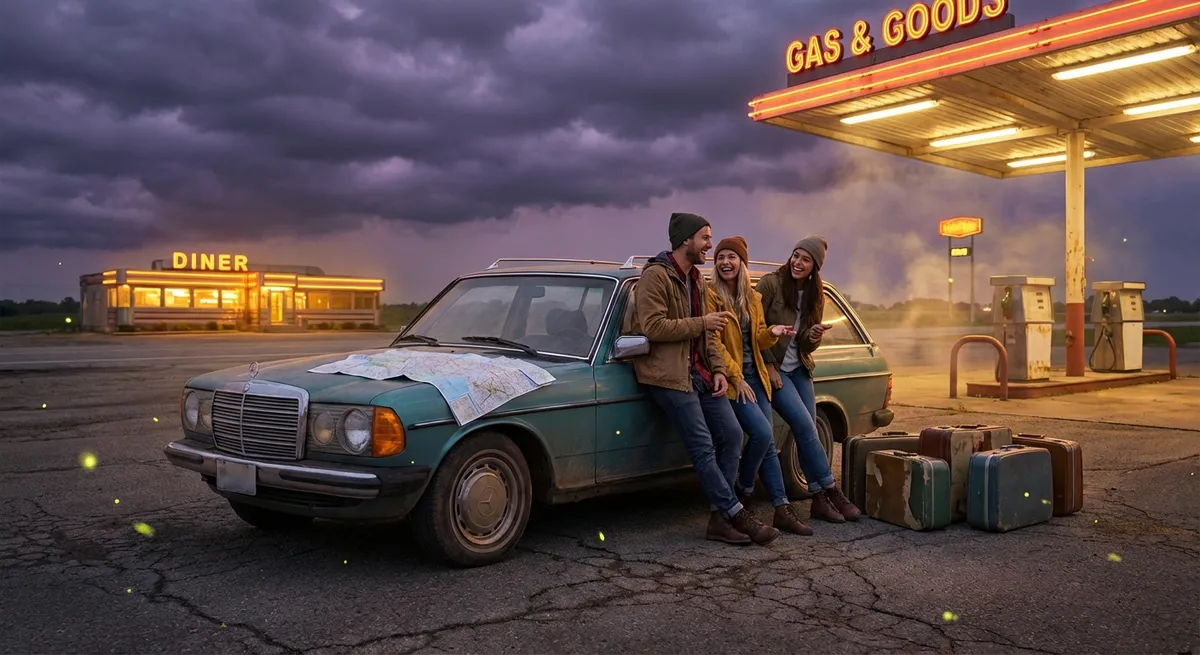
Some trips start with a packed itinerary. The best ones start with a half-charged phone, a crumpled map in the glove compartment, and a vague idea that “west” feels like the right direction. Road trips aren’t just about reaching a place on the map; they’re about what happens in the blank space between dots, the tiny detours that turn into stories you tell for years.
This is a story-led guide to hitting the road: five lived-in experiences, tips, and destinations that glow a little brighter once the sun drops and the mileage climbs. Consider it a nudge to throw your bag in the backseat, roll the windows down, and let the road redraw your plans.
1. The Night the Highway Went Dark – Learning to Love the Unexpected
We hadn’t planned for the power outage. The navigation was set, the playlist was perfect, and the interstate through the desert was supposed to be an easy, starless tunnel of taillights. Then, like someone flipped a cosmic switch, the rest stop lights died, the gas station sign went black, and the world beyond our headlights disappeared.
What we got instead of convenience was silence—and stars. With no light pollution, the sky exploded into a dome of galaxies we hadn’t seen since childhood. We parked on the shoulder of a quiet service road, killed the engine, and suddenly the hum of the highway became a distant rumor while crickets and coyotes took over the soundtrack. We lay on the warm hood, tracing constellations we could barely name and laughing at how rattled we’d been just fifteen minutes earlier.
The lesson arrived quickly: the best road trip moments rarely match the mood board in your head. A closed pass might reroute you through a tiny town with the best cinnamon rolls you’ve ever tasted. A rained-out hike might turn into a long, slow breakfast with locals who’ll redraw your map with pen and personal recommendations. The trick is to build a loose plan but fall in love with Plan B, C, and D.
Practical tip: download offline maps before you leave cell coverage, keep a physical map in the car, and stash a small “unexpected kit”—headlamp, portable battery, snacks, and a printed list of emergency numbers. That way, when plans unravel, you’re annoyed for five minutes instead of stranded for five hours.
2. Coastal Mornings & Foggy Coffee – Chasing the Edge of the Continent
There’s a particular kind of morning you only get on coastal road trips. The world is gray, the ocean is a rumor behind a curtain of drifting fog, and the air is cool enough that your first breath feels like a reset button.
On one such morning, we pulled into a cliffside turnout still half-asleep. The sun hadn’t committed to rising yet. From the car, the view looked like a blank white wall. But when we stepped toward the guardrail, the fog thinned just enough to reveal miles of raw coastline—waves slamming into rock, seabirds drafting the wind, a lone fishing boat carving out a white path.
Our coffee came from a tiny roadside shack that looked like it had survived a few storms. Inside, a handwritten sign reminded travelers to “Take your time; the road isn’t going anywhere.” Locals in rubber boots and weathered jackets knocked sea salt off their shoes while talking about tides, storms, and whether the whales would be visible by noon.
Coastal drives, whether you’re tracing the Pacific, the Atlantic, or a rugged northern shoreline, offer a rare combination of motion and meditation. Each curve reveals a new frame: empty beaches, lighthouses perched on impossible cliffs, sleepy harbors where boats outnumber people. The road winds and narrows, forcing you to slow down and savor.
Practical tip: plan fewer miles per day on coastal routes than you would inland. You’ll want time for tide pools, impromptu photo stops, slow seafood lunches, and lingering at overlooks until the sun finds a gap in the clouds. Check tide charts and coastal weather ahead of time; some of the best experiences—like walking across wet sand to a sea stack or exploring a cove—depend on timing the ocean’s mood.
3. Backroads, Barn Cats & Pie for Breakfast – Falling in Love with Small-Town Detours
The interstate was faster, smoother, and utterly forgettable. The backroad, on the other hand, came with a hand-painted sign that read: “PIE, COFFEE, STORIES – NEXT RIGHT.” We didn’t stand a chance.
The town wasn’t really a town, more like a cluster of buildings gathered around a two-lane road and a gas station. The café was attached to a feed store, with a screen door that squeaked like it was under contract. Inside, the specials were written on butcher paper: “Apple, Cherry, Pecan, and Whatever Linda Just Made.” Pie for breakfast felt like a crime worth committing.
We shared a table with an older couple who’d been driving the same route for 40 years. They told us about the flood that nearly took the bridge, the fair that shut down when the ferris wheel broke, and the one summer a Hollywood film crew turned the town into a movie set. Before we left, the owner drew us a quick map on a napkin: a shortcut through farm roads that passed an old covered bridge and a field where, “if you’re lucky,” you might see a herd of elk.
Tiny towns turn a road trip into a rolling anthology of short stories. Each main street has its own voice: murals painted by high school students, historic plaques no one reads but everyone defends, and community boards filled with flyers for pancake breakfasts, lost dogs, and band practice in someone’s barn.
Practical tip: when you see a sign for a viewpoint, a farmers’ market, or a local festival, follow it at least once a day. Ask café staff or gas station attendants: “If I had one hour here, what should I not miss?” Their answers will unlock experiences that no travel app has fully captured yet—like a swimming hole only locals know, or a hillside where the sunset hits just right.
4. Mountains, Thin Air & That One Terrifying Switchback
Mountain roads have a way of exposing both your fears and your awe. The climb starts gently enough: forests thickening, temperature dropping a degree or two every few miles, a river keeping you company. Then the trees thin, the road narrows, and suddenly you’re threading hairpins carved into stone.
On one particularly steep ascent, the GPS optimistically said, “Continue for 27 miles.” The switchbacks stacked on top of each other like a staircase built by a mountain goat. Guardrails appeared and disappeared with no clear logic. The backseat went quiet. Every glance out the window was rewarded with a sheer drop that made our stomachs flip.
But then we reached a pullout just below the summit. The landscape opened like a secret: waves of peaks rolling off into the distance, patches of snow clinging to shaded gullies in late summer, a lake below that looked like a shard of blue glass. Suddenly, the white-knuckle driving felt like a fair price for this view.
High-altitude road trips rewrite your sense of scale. Towns shrink to dots, highways look like threads, and clouds drift closer than billboards. You learn to respect weather that changes every mile and to pack layers for a day that starts in t-shirt warmth and ends in fleece and beanie.
Practical tip: if you’re heading into serious elevation, know your vehicle and your body. Use lower gears on steep grades to save your brakes, watch your coolant temperature, and top off fluids before the climb. For yourself, hydrate more than you think you need, take breaks to acclimate, and respect signs that say “chains required” or “road closed”—those aren’t suggestions. Always check the latest mountain pass conditions and closures; in many areas, transportation or park service websites update daily.
5. Motels, Mixtapes & The Late-Night Parking Lot Dance
Not every story happens against a sweeping natural backdrop. Some of the most memorable road-trip moments unfold in the fluorescent glow of a motel parking lot at 11:47 p.m., somewhere between the place you left and the place you’re trying to reach.
We rolled into one of those roadside motels that come with doors facing the parking lot and an ice machine that sounds like it’s chewing boulders. Exhausted but wired from too much driving and cheap gas-station coffee, we debated going straight to sleep. Instead, someone reached for the speaker, another person opened the trunk for snacks, and the parking lot became an impromptu after-hours lounge.
A couple from two doors down joined us, pulled in by the music and the smell of instant noodles. They were driving cross-country to start new jobs. Another traveler, a solo cyclist transporting their bike in the back of an old hatchback, wandered over to recharge their phone and tell us about the hills we’d just casually driven over and they’d heroically pedaled across.
We traded playlists, road horror stories, and hard-earned tips: the cleanest rest stops, the diner with the best late-night pancakes, the scenic overlook everyone else misses because it’s on the “wrong” side of the highway. By midnight, the motel felt less like a waystation and more like a temporary little village of travelers on intersecting timelines.
Practical tip: build a small “comfort kit” that turns any motel room or rest stop into a slice of home—earplugs, a soft t-shirt or scarf that smells familiar, a compact speaker or headphones, a favorite snack, and a notebook or notes app to capture memories before they blur. Road trips are made of quick, transient connections; writing down names, towns, and stories preserves the mosaic long after the miles fade.
Conclusion
The map will tell you where the road goes. It won’t tell you about the stranger who’ll hand-draw you a better route on a napkin, the pie that tastes like a childhood you never had, or the way the sky looks when a power outage accidentally gifts you the stars.
Road trips thrive in the space between control and surrender. You plan enough to be safe and comfortable, then leave the rest open for surprise: a foggy coastline, a backroad café, a mountain switchback that scares you awake, a motel parking lot that turns into a tiny, temporary community.
At some point, every truly great trip shifts from “Are we there yet?” to “Let’s see where this goes.” When that happens, you’re no longer just driving a route—you’re living a story. All that’s left is to pick a direction, pack lightly, and trust that the most important part of the journey will be the detours you couldn’t possibly have planned.
Sources
- National Park Service – Road Trip Planning and Safety Tips - Guidance on safe driving, weather awareness, and planning for national parks and scenic routes
- U.S. Department of Transportation – Traveler Information - Official resources for road safety, travel advisories, and infrastructure updates
- AAA – Road Trip Planning Resources - Tools and advice for mapping routes, finding services, and preparing your vehicle
- Outdoor Project – Scenic Drives & Road Trips Guides - Inspiration and detailed ideas for scenic road trips in various regions
- National Oceanic and Atmospheric Administration (NOAA) – Weather and Travel - Reliable weather and travel-safety information, especially useful for mountain and coastal routes