
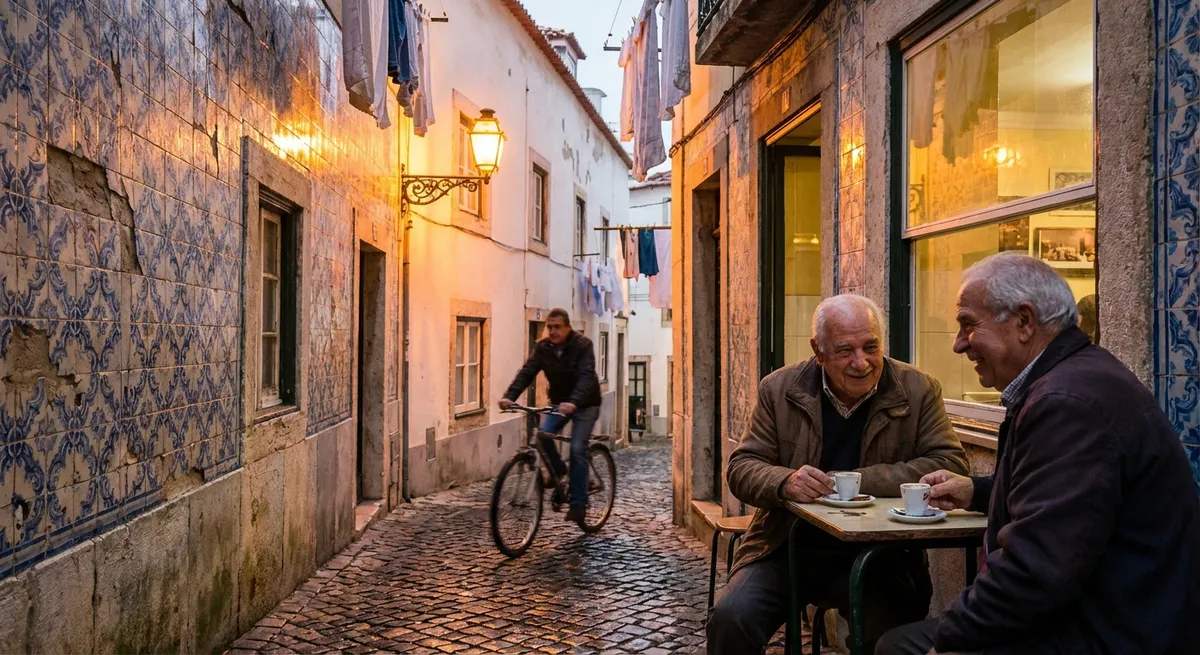
Some cities introduce themselves with monuments and skylines. Others whisper their names in the steam rising from a food stall, in the echo of a tram on wet tracks, in the hum that lives one street away from the tourist trail. This is a story about those quieter frequencies—five city experiences that don’t shout, but somehow stay with you far longer than your camera roll.
These aren’t bucket‑list “must-sees” as much as “come‑back‑to” moments: small discoveries, unexpected routes, and ways of slipping sideways into a city until it feels almost familiar, even if you’ve only been there a day.
1. Dawn Markets in Lisbon: Learning a City by Its Groceries
Lisbon doesn’t wake up all at once. It stretches. Shutters roll up, pigeons claim the tram lines, and the steep streets turn gold before most cafés have pulled their first espresso. If you follow the clatter of crates and the soft chorus of bargaining voices, you’ll find the city’s heart beating under fluorescent lights: the morning markets.
Mercado da Ribeira is the best-known, but the quieter neighborhood markets—like Mercado de Campo de Ourique or Mercado de Arroios—tell a softer story. You step through the doors and the air changes: fish on crushed ice, oranges stacked in small suns, bundles of cilantro and mint spilling perfume into the aisles. Elderly women tap melons with something like intuition; a vendor slices a sliver of cheese and raises an eyebrow toward you in silent invitation.
Walking those aisles is a crash course in how Lisbon eats and lives. You learn that bacalhau (salted cod) can be prepared in so many ways it might as well be a verb. You notice that people greet each other by name, that the butcher knows who cooks for a family of five and who lives alone. This is a city, cataloged in olives and bread rolls.
If you go, carry small coins and big curiosity. Ask vendors how they’d cook what they’re selling. Buy something you don’t recognize and Google it later over a coffee in a nearby pastelaria. Let breakfast be whatever the city hands you in a paper cone: roasted chestnuts in winter, a still-warm pastel de nata, or seasonal figs you’ll never quite forget.
The secret: markets are time machines. Spend an hour watching how people shop and you’ll see yesterday’s habits, today’s trends, and tomorrow’s cravings folding into one place. It’s urban anthropology with a pastry in your hand.
2. Rooftop Shadows in Athens: Finding Quiet Above the Ruins
Athens is loud: scooters, street music, the crackle of traffic and conversation. But the most surprising moments here happen above that volume, on rooftops that watch the city like patient spectators.
Near Monastiraki, you climb narrow staircases in old buildings—no elevator, just worn marble steps and the faint smell of coffee from someone’s apartment. A simple door pushes open, and suddenly the city expands in every direction. The Acropolis glows like a lantern on its hill, while laundry flaps on nearby balconies and satellite dishes point to distant conversations.
Rooftop bars get crowded after dark, but late afternoon is the city’s reflective hour. Order a Greek coffee or a cold beer, claim a wobbly table, and just sit. At eye level, you see pigeons landing on terracotta roofs, cats pacing along ledges with the confidence of landlords, and the subtle shifts of a city reset between day and night. Down below, people hurry. Up here, time slows.
These rooftops are also classrooms in disguise. Someone will inevitably point at a hill or dome and tell a small story—about protests, about music, about how Athens used to be before the new metro line. You’ll leave with tiny fragments of living history that never make it into guidebooks.
To unlock these spaces, look for signs in stairwells: “Roof Garden,” “Terrace Bar,” or nothing at all—just muffled music and the faint clink of glasses overhead. Follow the sound. The height doesn’t matter as much as the angle; sometimes, the best view is not the Acropolis itself, but the way its outline appears reflected in nearby windows at sunset.
The secret: Athens’s true drama isn’t only in its ruins; it’s in the way modern life wraps around them. Rooftops show you that embrace.
3. Tram Windows in Prague: Riding Through Someone Else’s Routine
Some cities are meant to be walked; Prague is also meant to be watched from a tram window, the city sliding past like a long, illustrated story.
You board an old red-and-cream tram in the late afternoon, maybe Line 22 or another route that touches both the familiar and the forgotten. The interior smells faintly of metal and dusted upholstery. When the doors shut with a mechanical sigh, you’re no longer just a traveler—you’re an extra in a hundred small daily plots.
Outside, the city rearranges itself every few seconds: a baroque church shoulder-to-shoulder with a minimalist café; a toy shop with wooden marionettes next to a tiny Vietnamese bistro; a courtyard where ivy has decided to own the entire wall. People get on and off with grocery bags, flowers, sports equipment. A teenager in a denim jacket stares out the window in the exact same way you do, but for her this is just Tuesday.
You begin to understand distances that maps flatten. That castle on the hill becomes the place you see from three different angles. A bridge appears first as a silhouette, then as an underpass, then as the frame for a river you’ll recognize again later from the opposite bank.
The practical tip: buy a day pass. Then, instead of hunting for the “perfect” sights, pick a direction and ride it nearly to the end. Get off where the crowds thin, in a residential district where corner bakeries outnumber souvenir shops. Find a park bench. Notice that the city’s rhythm here is completely different—less performance, more heartbeat.
The secret: public transportation isn’t just logistics; it’s narrative glue. Trams connect not just neighborhoods, but versions of a city that rarely appear in the same photo.
4. Sidewalk Picnics in Seoul: Eating the City One Plastic Stool at a Time
Seoul’s streets are full of neon and noise, but some of its most memorable moments happen inches above the pavement, on a plastic stool beside a fold-out metal table, in the glow of a food stall light.
Around Jongno or near Gwangjang Market, you’ll see them: clustered canopies, steam rising in fragrant plumes, ajummas (older women) managing fiery pans and mountains of ingredients with choreographed efficiency. You sit, and the city narrows to a bowl or plate right in front of you.
Maybe it’s tteokbokki—rice cakes in a sauce the color of a traffic warning, sweet and spicy in equal parts. Maybe kimbap slices rolled tight like edible exclamation points. Or hotteok, sugar-filled pancakes that taste like every carnival you never went to. Strangers sit elbow to elbow, business people in suits next to students, next to jet-lagged wanderers like you.
In a city famous for high-tech everything, these street-side meals are beautifully analog. No reservations. No elaborate plating. Just the rhythm of chopsticks, the sizzle from the griddle, and the occasional gust of cold air reminding you that winter here is real and unapologetic.
If you feel shy about language, let hunger lead. Point, smile, ask “mae-wo-yo?” (Is it spicy?). Most vendors have fed enough hesitant visitors to understand exactly what you mean by a raised eyebrow and a hopeful grin.
The secret: food stalls are pocket-sized neighborhoods. Regulars greet each other, gossip drifts over the chili steam, and your presence is just another thread in the nightly fabric. You’re not just eating in the city; for a brief moment, you belong to it.
5. River Walks in Chicago: Letting the Skyline Lean In Close
Chicago’s skyline doesn’t keep its distance; it leans toward the water like it’s trying to see its own reflection better. Down on the Riverwalk, beneath street level, you can walk through that reflection until the city feels almost close enough to touch.
You descend a staircase from the busy streets above and the soundtrack changes: traffic fades, replaced by the creak of tour boats, the murmur of conversations, the soft slap of water against concrete. The famous skyscrapers—art deco, glass-and-steel, modern experiments—are no longer an abstract horizon line. They’re pillars on either side of a slow-moving corridor of light.
As you walk, the city rearranges itself with every bend of the river. One angle is all angular power; another reveals unexpected curves and quiet terraces. Office workers grab a quick drink on patios that float just above the water; joggers pass in streaks of neon; a couple pauses at the railing, pointing at a building like they’re choosing a future apartment in the air.
Take your time here, especially around sunset. The glass towers catch the sky and hand it back, re-colored and fractured. Bridges lift and lower; trains rumble overhead; somewhere, a saxophone on a boat bleeds into the sound of clinking glasses.
If you want to understand how Chicago became a city that thinks in steel and water, consider a short architecture river cruise. Guides talk about setbacks and styles and the way the city rebuilt itself after the Great Fire. You’ll step off not just with photos, but with a sense that every building has a personality—and a past argument with gravity.
The secret: walking at river level turns a postcard skyline into an experience you can stroll inside. You stop being a spectator and become part of the scene, reflected in a hundred windows.
Conclusion
Cities don’t live only in their landmarks; they breathe in markets at sunrise, rooftops at dusk, tram rides at rush hour, stools pulled up to food stalls, and reflections drifting across rivers. When you travel, you’re not just collecting places—you’re collecting versions of yourself that only appear in those specific streets, at those exact times.
The next time you escape to a city, try slipping sideways off the main avenue. Follow the grocery bags, the tram tracks, the smell of something sizzling, or the tug of water between buildings. Wander until the city stops performing for you and starts simply being itself.
That’s where the stories you’ll keep retelling—long after the trip ends—quietly begin.
Sources
- Visit Lisboa – Lisbon Markets Guide – Overview of major markets and neighborhood spots in Lisbon
- This Is Athens – Official City Guide – Practical information on neighborhoods, rooftops, and cultural highlights in Athens
- Prague Public Transit (DPP) – Official site with tram maps, routes, and passes that make exploratory rides easy
- Korea Tourism Organization – Street Food in Seoul – Background on popular street foods and market areas in Seoul
- City of Chicago – Chicago Riverwalk – Details on the Riverwalk’s layout, access points, and attractions