
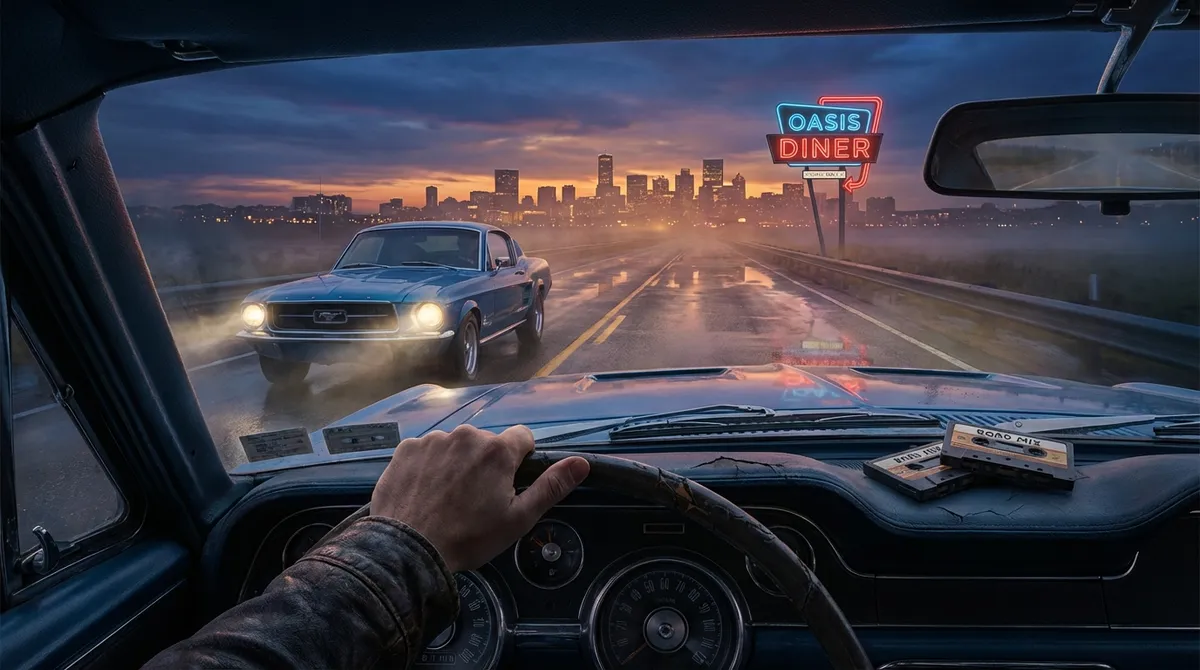
The best road trips don’t start when you turn the key; they start the moment an ordinary week feels too small for your imagination. This is for the part of you that wants the hum of the highway, the surprise of a small-town festival you didn’t plan for, and the quiet of a lookout point you stumble on at the blue edge of dusk.
Pack lightly, toss your expectations in the glove compartment, and come along for five road-trip experiences that feel less like itineraries and more like stories you get to finish yourself.
When the City Lights Fade: Chasing Dark Skies and Falling Stars
You don’t realize how loud a city is until you leave it behind in the rearview mirror. The night you chase the stars begins with traffic, billboards, and the frantic glow of brake lights—then gradually, the sky starts to widen and the neon gives way to shadow.
Dark-sky road trips are a quiet rebellion against the everyday. You drive toward those places where streetlights finally give up: national parks, remote deserts, high mountain passes. The world narrows to the cone of your headlights and the steady rhythm of lane markers ticking by. Somewhere off a two-lane highway, you pull into an unremarkable gravel turnout that you found on a stargazing map. It looks like nowhere. That’s exactly why you’re here.
You step out and the silence hits first. Then, as your eyes adjust, the sky fills in—stars you didn’t know existed, a hazy ribbon of the Milky Way, maybe a flash of a meteor that vanishes before you can point it out. A thermos of coffee becomes your campfire. The trunk becomes your couch. Talk slows. Breathing slows.
Practical magic: use a light pollution map to find dark-sky zones and plan your drive so you arrive after astronomical twilight. Keep your headlights, phone brightness, and flashlights low—your eyes need time to adapt. And don’t plan every viewpoint; road trips are built on maybes. “Maybe we pull over there.” “Maybe we stay longer.” Under a truly dark sky, “maybe” becomes the best itinerary you ever had.
Side-Road Serendipity: Following Hand-Painted Signs Instead of Algorithms
There’s a special kind of freedom in ignoring your GPS for a while and trusting the universe of hand-painted signs. You’ve seen them: “Fresh Peach Stand 2 Miles,” “World’s Best BBQ Next Exit,” “Antique Barn — Open if Door’s Open.” They’re not optimized for search engines. They’re optimized for curiosity.
One afternoon, a simple highway drive can tilt sideways into a story. You spot a lopsided sign promising “Homemade Pie” and, without thinking too hard, you take the exit. Asphalt turns to cracked county roads. The town you roll into is a cluster of weather-faded buildings, a single gas station, and a diner with a neon sign that only half works. Inside, it smells like coffee and butter and something baking.
The pie is good, of course, but the point is everything around it. The waitress calls you “hon.” There’s a local notice board with handwritten flyers for a community play, a lost dog, and a farm that will let you pick your own apples. Someone at the counter asks where you’re from, not to sell you anything, but because they truly want to know who wandered into their corner of the map.
These little detours become your road trip’s secret backbone. Algorithm-free travel means building in extra time: an extra hour in the day that doesn’t “belong” to a hotel check-in or a planned activity. Let the hand-painted signs, the tiny museums with $3 admission, and the one-lane bridges dictate the plot. When you look back, the thing you remember usually isn’t the interstate—it’s the pie that made you turn off it.
Highways of Memory: Re-Driving the Roads You Once Knew
Some road trips are about new horizons; others are about old ghosts. Returning to roads you haven’t driven in years—the route to your college town, the highway to your grandparents’ house, the coastline you once drove with someone you haven’t spoken to in a decade—hits differently.
The landscape is a palimpsest. The new coffee shop sits where that video rental store used to be. The big oak tree you used as a landmark is gone, but the bend in the road where you first learned to handle a curve is still there, unchanged. You drive slower than you used to, partly because of speed limits, mostly because every mile is pulling up a memory.
You pass the gas station where you filled up your first road-trip car with coins scavenged from couch cushions. The overlook where you once sat on a hood, sharing secrets under a sky that felt endless. The roadside motel that seemed sketchy back then now just looks…human-sized. Familiar. You start to realize that you’re not just revisiting geography—you’re revisiting past versions of yourself.
For this kind of road trip, pack artifacts: an old playlist, a printed map with routes you used to trace with your finger, maybe a photo tucked into the sun visor. Notice what has changed, but also what hasn’t: the shape of the hills, the cut of the river, the way the air smells when the windows are down. Let yourself feel nostalgic without trying to force closure. The road doesn’t offer tidy endings. It offers perspective.
The 3:00 A.M. Drive: Chasing Sunrises and Empty Roads
There’s a peculiar thrill to starting a road trip when everyone else is asleep. The alarm goes off at 2:30 a.m., and it feels slightly unhinged to be packing the car in the dark, but this is part of the ritual. The world is quiet and blurry as you merge onto a nearly empty highway, the lines on the road stretching into a tunnel of possibility.
At first, it’s just you, the dashboard glow, and whatever playlist you trust at that hour. The night sits heavy on the windshield; truck stops become your only beacons. But gradually, the darkness thins. A faint line of silver appears on the horizon, and the sky starts to bruise pink. You crack the window; the air is cold, raw, untouched by the day’s heat or noise.
You pull over at a random exit just as the sun breaks—a rest area, a field edge, a beach parking lot. It doesn’t have to be “scenic” in the traditional sense; the sunrise does the work. Light spills over the hood of your car, washing out the fatigue and replacing it with something like possibility. There’s coffee in a travel mug, crumbs from a gas-station snack, and the feeling that you’ve somehow stolen a few extra hours of life.
There are practical safety notes: rest before you drive at odd hours, share driving if you can, and build in a mid-morning nap stop so you don’t push past your limits. But done right, the pre-dawn leg of a journey turns a simple drive into an experience that feels almost secret. It belongs to you and the road and the first light of day.
Turning the Car into a Moving Living Room
At some point on a long drive, your car stops being just a vehicle and becomes a temporary home. The passenger seat morphs into a snack bar. The dashboard collects sunglasses, toll tickets, and scribbled notes about a trailhead you heard about at the last gas station. The backseat, if you’re honest, devolves into a soft chaos of hoodies, guidebooks, and someone’s half-deflated travel pillow.
Leaning into this transformation can make the journey as satisfying as the destination. Curate a “glove box library” of short stories, zines, or local brochures you pick up along the way. Build soundscapes that match the mood: road-trip podcasts for mid-day stretches, quiet instrumentals when landscapes get dramatic, nostalgic tracks when the sun starts to drop behind the fields.
Meals become mini-adventures instead of obligations. One day it’s a carefully packed picnic eaten on the hood while watching storms form on a distant horizon. Another day it’s an impulsive stop at a food truck in a grocery store parking lot that ends up serving the best tacos of the trip. The key is to let the car be flexible: workspace, nap pod, observation deck, confessional booth.
A few deliberate choices help: a small tote with “everything you want within arm’s reach,” a dedicated place for trash, and one shared rule you never break (like “we always pull over for scenic overlooks” or “we always try the local dessert once”). These rituals turn a random series of drives into one continuous, stitched-together story—a traveling living room with ever-changing walls.
Conclusion
Some journeys are measured in miles; the good ones are measured in stories. Dark skies that make you feel small in the best way. Hand-painted signs that reroute your afternoon and, maybe, your mood. Old roads that show you how far you’ve come. Sunrise highways that feel like a secret handshake with the day. A car that stops being a shell of metal and starts feeling like a moving chapter of your life.
The next time the week feels too small, listen to that restless part of you. The map is only a suggestion. The road is waiting. And somewhere beyond your usual exit, a story is already warming up its engine, hoping you’ll decide to go find it.
Sources
- National Park Service – Stargazing Tips – Practical guidance on finding dark skies, preserving night vision, and safely enjoying nighttime environments
- International Dark-Sky Association – Directory of designated dark-sky parks and communities that are ideal for night-sky road trips
- U.S. Department of Transportation – Rural Roadway Safety – Information and best practices for safely driving on rural and less-traveled roads
- National Highway Traffic Safety Administration – Drowsy Driving – Evidence-based advice on avoiding fatigue, especially relevant for early-morning or late-night road segments
- AAA – Road Trip Planning Resources – Tools, destination ideas, and safety considerations for planning memorable road trips