
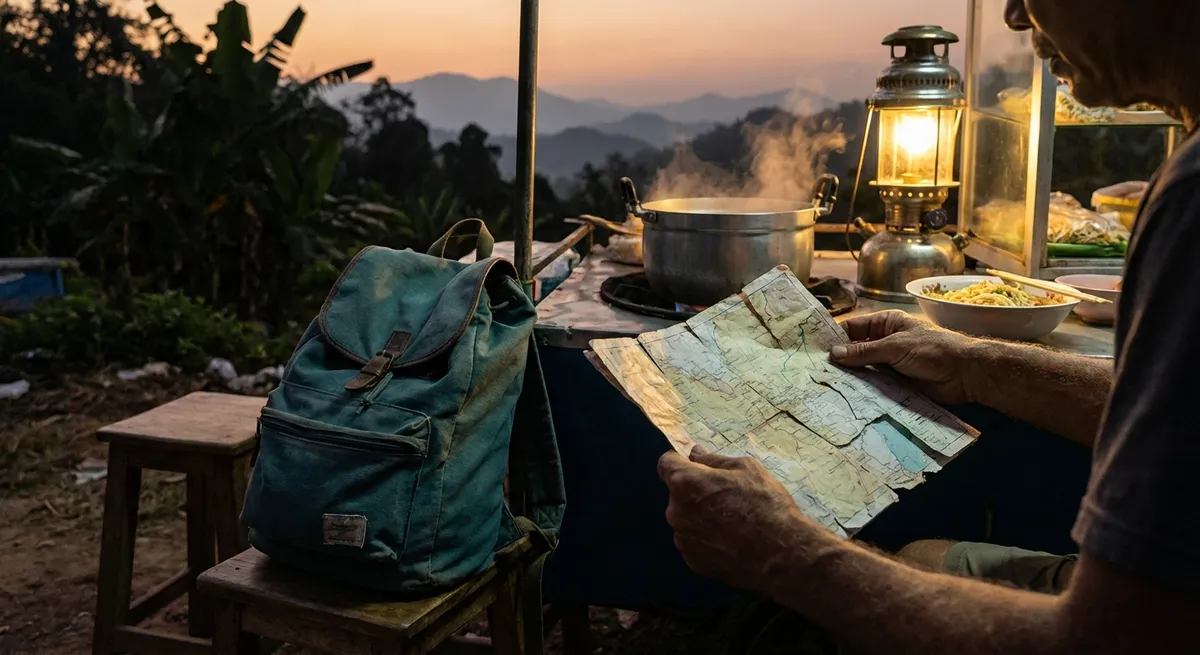
There’s the trip you book—and then there’s the trip that actually happens. The second one is where the stories live: the missed trains, the unexpected invitations, the wrong turns that somehow lead to the exact right place. This isn’t a list of “top 10” anything. It’s a patchwork of five journeys—part memory, part guide—that invite you to travel the way stories unfold: slowly, unexpectedly, and just a little bit off-script.
Dawn on the Sleeper Train: Learning to Share Silence
The train left Paris long after the city had gone soft and blurry with lights. The platform smelled like metal and rain, that particular scent that always feels like departure. I had a ticket on the overnight train south—a narrow bunk, a worn blue curtain, and the quiet thrill of going to sleep in one life and waking up in another.
My compartment was a collage of strangers: an elderly woman with a floral scarf, a student losing a battle with a tangled pair of headphones, and a man reading a paperback with the spine torn nearly in half. We traded the usual nods, that fragile, wordless agreement that we’d share this small space and keep each other’s lives intact until sunrise.
As the train slid out of the station, the city peeled away and dark fields took over. I watched the reflection of my own face hover over the night outside, layered with the silhouettes of people I didn’t know but somehow trusted. The rhythm of the tracks took over, a steady lullaby of steel and distance.
In the flickering half-sleep of the sleeper car, something shifted. The student, realizing her charger didn’t match the outlet, shyly asked if she could borrow mine. The older woman unwrapped a small packet of biscuits and offered them around like we were her family and not four souls thrown together by an algorithm and a timetable. We drifted between languages, between full sentences and comfortable silence.
The tip hidden in this story is simple: if you can, take at least one night train in your lifetime. Not just for the romance of it, but for what it forces you to practice—patience with strangers, sharing of small comforts, and the gentle art of doing absolutely nothing while the world outside rearranges itself.
When you travel this way, you’re not just moving across a map—you’re borrowing a night from other people’s lives. It’s a reminder that travel isn’t only about what you see when you arrive. It’s also about who you briefly become on the way there.
A Village With No Name on the Ticket: Following the Bakery Smell
The bus was supposed to stop in a town with a real name, the kind you’d find in guidebooks and on souvenir magnets. Instead, it shuddered to a halt in a place the driver called “just before there,” and I watched with mild panic as everyone who looked like they knew what they were doing got off.
Outside, there was no grand square, no famous sight, just a road, a handful of low stone houses, and an air that smelled unmistakably of fresh bread. The driver shrugged when I asked if this was the right stop. “You can wait for the next bus,” he said, “or you can look around.” That was it—the official invitation.
Curiosity won. I stepped off the bus and into a village that felt like it had forgotten to be discovered. The bakery appeared first, the way good bakeries always do—announced by warmth and the slow thud of dough against an unseen counter. Inside, the glass case was fogged with heat and sugar; a woman dusted flour from her hands like she’d been doing it for centuries.
I ordered by pointing, unable to pronounce half the names, and ended up with a paper bag of still-warm pastries I hadn’t meant to buy. I ate the first one leaning against a stone wall, watching schoolchildren run home, their backpacks bouncing like punctuation marks. In that moment, I felt the kind of quiet happiness that never fits into an itinerary.
Here’s the lesson this tiny, almost-accidental stop offers: leave one piece of your day unplanned. That’s it—just one window of time where your only rule is to follow something simple and human. Follow the smell of bread, the sound of laughter, the line of locals snaking around an unknown door.
It doesn’t have to be a picturesque village. It can be a side street in a city, an alley off the main boulevard, a neighborhood café that doesn’t appear on any “must-visit” list. Let your senses, not your search results, guide you for at least an hour. What you’ll remember years later won’t be the famous landmark perfectly framed in your camera—it will be the taste of whatever you stumbled into by mistake.
The Market at Midday: Learning a New Language Without Words
Some places roar; others hum. The market in this coastal city did both at once.
It was noon, the sun high and unforgiving. Tarps in faded blues and greens sagged overhead, casting uneven shade while fans buzzed and old radios argued with each other from different stalls. Spices spilled in careful pyramids, fish lay on ice like silver commas, and somewhere a woman laughed so loudly that three stalls turned to look.
I didn’t speak the language. Not really. I had three phrases, a handful of numbers, and a smile I tried not to weaponize with too much tourist guilt. But markets are generous teachers, and they speak in a kind of universal grammar: gesture, repetition, negotiation, and play.
At one stall, I pointed to a small mountain of figs, and the vendor responded with a theatrical frown. Too few, his hands said. He added two more to the bag with a flourish, then weighed it again with the solemnity of a judge. I paid, and he tucked an extra fig in on top, almost conspiratorial. “For walking,” his eyes told me.
At another table, I watched a grandmother bargain so fiercely for a bundle of herbs that the vendor finally surrendered, laughing and pretending to clutch his heart. The people around them grinned. This was theater, ritual, and economy braided together.
This is where a deeper travel tip hides: spend time in a place where daily life is loud and unpolished. Markets, bus stations, barber shops, neighborhood parks—these are the unscripted stages where a destination explains itself when it thinks no one official is listening.
You don’t have to understand every word. Pay attention to rhythm: how people wait, how they argue, how they joke, how they say “thank you” or “never mind” or “come back tomorrow” with their hands, their shoulders, their laughter. You can learn more about a country’s soul in an hour of untranslatable gestures than in a day of museum labels.
And if you’re nervous about intruding, remember this: you belong there as long as you are gentle with your gaze, fair with your money, and humble with your camera. Buy something small. Say thank you in the local language, even if you mispronounce it. Let the market teach you that travel isn’t just about seeing new things—it’s about seeing familiar human behaviors in unfamiliar colors.
The Rainstorm Detour: When Weather Erases Your Plans
The forecast had promised “light showers.” The sky had other ideas.
I had come to this coastal town to hike a cliffside trail that every blog and brochure swore would change my life. Instead, two hours before I reached the trailhead, the heavens opened like a broken faucet. Streets turned to mirrors, umbrellas bloomed, and the mountains vanished behind a curtain of unapologetic gray.
There is a unique, sharp disappointment that comes when a long-anticipated plan dissolves in front of you. You don’t want to be “chill” about it. You want the weather to apologize personally.
I stood under the awning of a shuttered souvenir shop, sulking, when a woman with a key ring and a brisk smile appeared. “Closed today,” she said, noticing my face tilt toward the locked door, then towards the flooding gutters. She looked me over once, then nodded to the right. “There is a teahouse. Better view when it rains.”
It sounded like a consolation prize. It turned out to be the center of the day.
Up three worn stone steps and through a sliding wooden door, the teahouse was a warm pocket of time. Windows fogged and cleared with every change in the room’s breath. Shelves held teapots in every shade of earth. A curtain of glass beads swayed near the rear, marking the threshold between guest and kitchen.
I sat by the window, and the owner placed a small tray in front of me—a clay pot, a cup, a bowl of sugar I never used. For an hour, I watched rivulets of water race each other down the glass, blurring the town into a watercolor. Locals trickled in, shaking off umbrellas, shedding jackets, nodding to each other with the familiarity of shared weather.
The tip from this washed-out day is harsh and freeing: build space in your plans not just for what you want to do, but for what might never happen. Something will close unexpectedly. A strike will cancel trains. A storm will claim your hike. Ask yourself in advance: “If none of this happens, what kind of day do I still want to have?”
Then pack for it—not just with raincoats and backups, but with a mindset that actively expects at least one disappointment to evolve into a different kind of memory. Sometimes the view you were promised disappears, and you’re left instead with the sound of rain on a teahouse roof and the discovery that slow, enforced stillness suits you more than any sweeping panorama.
The Last-Night Conversation: Why Departures Make Us Honest
It was the last night in a city that already felt like a memory: the cobbled streets, the crooked balconies, the laundry lines strung like musical staves between buildings. My hostel’s rooftop was a mismatch of plastic chairs, potted plants that had given up, and a small bar where the bartender knew exactly three cocktails and made them all with equal enthusiasm.
We were a predictable mix: a couple from Canada comparing tans, a solo backpacker who had been “on the road for eight months, maybe nine,” two friends arguing over directions for the next day. We’d nodded to each other in the hallways, swapped Wi-Fi passwords, complimented each other’s shoes, but never really gone beyond surface-level.
Then someone mentioned it was their last night. Then someone else added, “Mine too.” Like a spell being broken, everyone admitted it. Flights in the morning. Trains at dawn. One more bus, one more border, one more goodbye.
Something shifts when people know they are about to disappear from each other’s lives. The small talk loosens its tie.
The Canadian couple confessed that they’d had their worst fight ever two nights ago, standing in front of a cathedral, arguing not about dinner but about whether they wanted the same life after the trip. The long-term backpacker admitted he was tired—tired of constantly introducing himself, of always being the new person, of feeling like he wasn’t really living anywhere, just orbiting his own life.
We talked about the strange pressure to “make the most of it,” the Instagram highlights that swallow all the quiet, boring, necessary parts of a trip. Someone admitted they’d spent an entire afternoon in bed just watching local game shows. No regrets.
This is the quiet invitation of travel: find at least one place and one night where you let the mask of “perfect trip” drop. It doesn’t have to be a hostel roof. It might be a late dinner with a new friend, a long train ride where you finally tell the truth when someone asks, “So, why did you really come here?”
You don’t owe your full story to every person you meet on the road. But when you offer a little more honesty—to yourself and others—you collect something deeper than souvenirs. You gather proof that travel isn’t just a parade of pretty places. It’s a mirror held up to who you are when no one knows your past and no one expects your future.
Those last-night conversations tend to stay with you longer than the view from the most-photographed overlook. They remind you that the real journey is as much inward as outward, and that sometimes the most important shift doesn’t happen on the map, but in the way you start answering the question: “Where are you going next?”
Conclusion
The best travel stories rarely match the original plan. They begin on sleeper trains where you learn to share silence, in unnamed villages that smell like bread, in markets where language collapses into gestures, in rainstorms that erase your carefully crafted days, and on rooftops where honesty finally outruns small talk.
If there’s a thread tying these journeys together, it’s this: let your trip be a little unfinished, a little uncertain, a little wild at the edges. Leave room for the places that aren’t in the brochure, the moments that don’t make the highlight reel, and the people you’ll never see again but will think about for years.
Somewhere between what you book and what actually happens, a truer kind of travel appears—the kind that doesn’t end when you come home, because it’s quietly rewritten how you see yourself, your days, and the wide, waiting world.
Sources
- UNWTO Tourism Highlights - Global tourism data and reports that contextualize how and where people are traveling today
- Lonely Planet – Travel Tips & Advice - Practical guidance on planning flexible, experience-focused trips
- BBC Travel – Destinations & Features - Narrative-driven travel stories and destination features for further inspiration
- National Geographic Travel - In-depth articles on cultures, landscapes, and immersive travel experiences
- U.S. Department of State – International Travel - Official safety, documentation, and planning resources for international travelers