
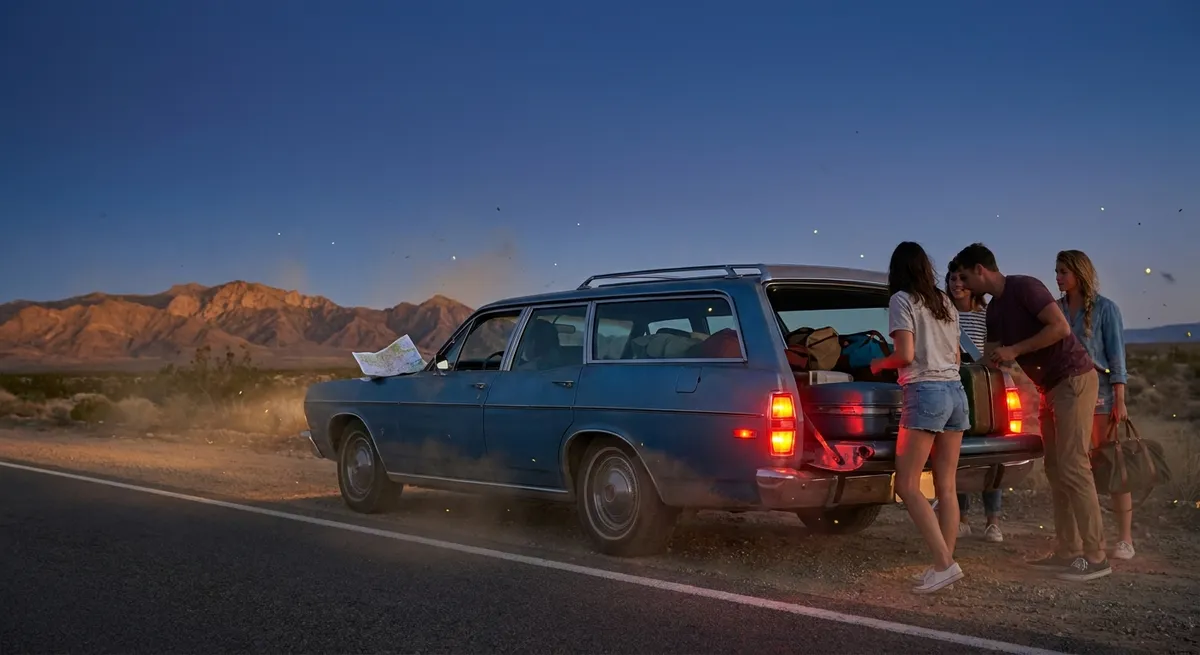
There’s a moment—right after the engine turns over and before the GPS locks in—when the whole world feels wide open. No boarding times, no security lines, just the quiet promise of “Let’s see where this goes.” Road trips aren’t just about getting somewhere; they’re about what happens in the in‑between. The gas station coffee that somehow tastes incredible at 2 a.m., the wrong turn that turns into the best view of your life, the tiny town you’ll think about years later. This is a journey through five road-trip moments—part story, part guide—that might just make you want to throw a bag in the backseat and drive.
1. The Sunrise That Changed the Playlist
There’s a highway in the American Southwest where the sky doesn’t just get lighter—it blooms. We’d left in the dark, the kind of 4:00 a.m. start that feels like a bad idea until you’re already twenty minutes down the road, commitment sealed by a drive-thru coffee. The world outside was only outlines: hills like shadows, cactus like silhouettes, the white dashes on the road sliding by like a metronome.
Then the horizon started to glow.
Not fast. First a band of gray, then a smear of pale pink. We turned the music down, not consciously, just an instinctive lowering of volume when something real starts to happen. I remember the way the light caught the cracked windshield, the way it turned basic dust into glitter. By the time the sun split the horizon, all of us were silent, faces tilted toward the glass like kids pressed to the window of a toy store.
What’s rarely mentioned in road trip tips is this: leave in the dark at least once. Aim to be in the middle of nowhere when the sun comes up. It doesn’t have to be a national park or some famous overlook. Any long stretch of open road works—somewhere the light has room to spill.
Practical note: check sunrise times before you go and plan your departure so you’re on a scenic stretch 20–30 minutes before dawn. The National Weather Service and most weather apps list sunrise times by city. Bring sunglasses, sure—but also bring silence. There’s something about turning the volume down that lets the world come rushing in.
2. The Town That Wasn’t on the Map (But Stays in Your Head)
We didn’t mean to find the town. That’s how these places always show up: accidentally. A missed exit, a “let’s take the slow road,” a curious detour when someone says, “What’s down there?” and points to a smaller, thinner line on the map.
The main road into the town looked like every other one-lane entry, but the smell was different. Warm dough, cinnamon, and something smoky. We rolled down the windows and followed our noses to a low brick bakery where the sign was missing half its letters. Inside, the owner greeted us like we’d parked in his driveway instead of his lot.
We sat in mismatched chairs, eating pastries that were almost too warm to hold. On the wall, there was a display of faded photos: high school teams, parades, grainy images of cars that looked like they belonged in museums now. When we said we were “just passing through,” he laughed and said, “Everyone thinks that. We tend to stick to people.”
And he was right. Years later, no one remembers the name of the highway we were technically supposed to be on. But everyone remembers that bakery. The way the owner wrapped an extra pastry “for the road” like he’d known us for years. The way time seemed to stop for an hour in that tiny, forgotten dot on the map.
If you’re planning your own drive, build in what travel researchers call “unscheduled time.” Both Visit The USA and national tourism boards quietly recommend doing less, not more. Intentionally leave open spaces in your daily plan—gaps where you’re allowed to follow a small sign that just says “Bakery” or “Scenic View” or “Farm Stand.” Some of your strongest memories will be things you never pinned on your map.
3. The Storm That Turned the Car into a Story Circle
The weather app had promised “light showers.” What we got felt like the sky deciding to empty an entire ocean at once. Wipers on high, visibility down to “Is that a truck or a mountain?” level, and the kind of thunder that shakes the steering wheel.
We pulled off at the first gas station we saw, joining a little collection of strangers hiding from the same storm. It was an unlikely place for magic: fluorescent lights, humming coolers, that mysterious stain every roadside gas station seems contractually obligated to have.
But once we admitted we weren’t going anywhere for a while, something shifted. Someone sat on the trunk of their car. Someone else dragged out a folding camp chair. People started talking. At first: where are you headed, how long have you been on the road, is it always like this here? And then: jobs, breakups, “craziest thing that ever happened to me on a road trip.”
The storm outside was relentless, but inside our little pocket of parked cars, the energy warmed. A family shared snacks from their cooler. One traveler showed us a hand-drawn map they’d been sketching of their route, adding tiny doodles for each memorable stop. We started trading stories like souvenirs.
If there’s a secret to handling bad weather on a road trip, it’s this: treat it as its own destination. The National Park Service and road safety guides will remind you to pull off safely, stay put, and wait out dangerous conditions. Once you’ve done that, you have two choices—complain about lost time, or let the delay become its own chapter.
Keep a small “storm kit” in your car: a pack of cards, a notebook, a paperback, maybe a tiny travel game. You can’t control the weather, but you can decide what kind of story you’re going to tell about it later.
4. The Night the Stars Replaced the Streetlights
Cities teach you to measure night by neon and windows. Out on the road, far from downtowns and suburbs, the dark is different. It’s bigger. Heavier. And above it, if you’re far enough from artificial light, there’s a sky you might not even recognize.
We found it by accident—again. The plan had been to make it to a larger town, but the day ran long and the last decent motel was an aging motor court with a flickering sign and a lobby that smelled like lemon cleaner and dust. The rooms were basic, but they were clean, and the owner mentioned, almost casually: “On a clear night, you can see the Milky Way from the back lot.”
We walked out after midnight, past the last row of parked cars, beyond the buzzing soda machine’s light, until the darkness felt almost physical. When our eyes adjusted, the sky came alive. Not a smooth navy blanket, but a depth—layer after layer of stars like spilled salt, faint bands of the Milky Way stretching across the heavens.
Someone lay down on the cool pavement. Someone else followed. We didn’t speak much; we just pointed. “Look there.” “Did you see that?” A shooting star. Then another. It felt less like watching the sky and more like realizing we’d been under it our entire lives without really seeing it.
Organizations like the International Dark-Sky Association actually map places where night skies are still protected from light pollution. If you’re planning a route, look for dark-sky parks or rural stretches within a short drive of your overnight stop. Check moon phases too—a new moon means darker skies and more visible stars.
You might forget the name of the motel. You won’t forget the way the sky looked when the streetlights finally stepped aside.
5. The Road That Didn’t Go Viral (But Should Have)
There’s a particular kind of road trip many of us have started taking: the “Instagram-famous” one. You know the routes—the ones with iconic overlooks and lineups of people all waiting to take the same picture. They’re popular for a reason; they’re often beautiful. But on one trip, we deliberately did something different: we picked the road that no one was talking about.
We traced a line across a paper map, connecting small towns that had no hashtags, no glossy listicles, no “Top 10 Hidden Gems” posts written about them. We chose roads that looked like afterthoughts—rural routes, older highways that had been bypassed by faster interstates.
What we found wasn’t drama or grandeur, but texture. Faded murals on brick walls. A farmer’s market in a parking lot behind a hardware store. A field of wind turbines turning slowly against a pale sky. A diner where the menu hadn’t changed in a decade, and neither had the waitress’ gossip about everyone who lived within a 20-mile radius.
Sociologists and travel researchers have written about the benefits of “slow travel,” a mindset that emphasizes connection over consumption. While popular destinations will always have their place, there’s something deeply grounding about choosing a road not designed to impress you, but simply to take local people home, to work, to school.
Before your next trip, try this: after you’ve plotted your main route, pick one day to leave the algorithm out of it. Don’t search “most beautiful road.” Instead, click on the satellite or terrain view of your map and look for a smaller road running near rivers, through foothills, or along the edges of small towns. Cross-reference it with your country’s official transportation or tourism site—like U.S. Scenic Byways or your local equivalent—to make sure it’s safe and maintained, then go.
Some roads will never go viral. They’ll just quietly offer you glimpses of real, everyday life. And sometimes, that’s the exact journey your restless heart has been asking for.
Conclusion
Road trips are rarely about the “big moment” you set out to find. More often, they’re made of a dozen small, almost throwaway scenes: a sunrise through a dusty windshield, a stranger’s kindness in a town you’ll never visit again, a storm that forces everyone to slow down, a night so dark the stars finally step into focus, a road that doesn’t exist on any must-see list but quietly reorients the way you look at distance and time.
If there’s a single thread running through these five experiences, it’s this: leave room. Room for detours, delays, surprise towns, and sky-wide silences. Plan enough to be safe. Prepare enough to be comfortable. But not so much that the road can’t whisper its own ideas into your itinerary.
Somewhere out there, a stretch of highway you’ve never driven is waiting with a story you don’t know yet. The tank doesn’t have to be full. The plan doesn’t have to be perfect. Sometimes, all you really need is the decision to turn the key and see what the next mile has to say.
Sources
- National Park Service – Road Trip Planning & Safety – Practical guidance on planning, safety, and making the most of scenic drives
- Federal Highway Administration – America’s Byways – Official directory of scenic byways and less-traveled routes across the United States
- International Dark-Sky Association – Information and maps of dark-sky parks and places ideal for stargazing on road trips
- U.S. National Weather Service – Road weather safety tips and best practices for handling storms and hazardous driving conditions
- Visit The USA – Road Trip Inspiration – Destination ideas, itineraries, and insights into exploring lesser-known American routes